
The French Basque Country, or Pays Basque, is a compact corner of southwest France where the Atlantic coast meets the Pyrenees foothills, and five to six nights is the right amount of time to see it properly. Base yourself in Biarritz or Saint-Jean-de-Luz, spend your days on the coast, in the red-and-white-shuttered villages of the interior, and over the border in San Sebastián, and go in June or September for the best balance of weather and calm. The TGV from Paris Montparnasse reaches Biarritz in roughly four hours1, so this is one of the easiest regions in France to add to a Paris trip.
When I plan trips for clients at France Awaits Travel, the Basque Country is the region that most often surprises people. It has its own language, its own food, a ball game played against a church wall, and a coastline that feels closer to the Spanish side than to Paris. Here is how I put a trip together.
How many days do you need in the French Basque Country?
Five to six nights lets you see the coast, the inland villages, and one big day trip without driving yourself ragged. Four nights works if you stay on the coast and take a single inland day. A week lets you add Saint-Jean-Pied-de-Port and a wine stop in Irouléguy.
A sample shape that I use often:
- Nights 1-3: Biarritz or Saint-Jean-de-Luz, with a day for the coast and a day for the Basque villages.
- Night 4: a day trip to San Sebastián, returning to your base for dinner or staying over in Spain.
- Nights 5-6: the interior, around Espelette, Ainhoa, and Saint-Jean-Pied-de-Port, ideally in a country inn.
Where should you base yourself: Biarritz, Saint-Jean-de-Luz, or Bayonne?
All three sit within a short train ride of one another. Biarritz to Bayonne is about ten minutes and Biarritz to Saint-Jean-de-Luz about fifteen by regional train1, so the choice is about atmosphere.
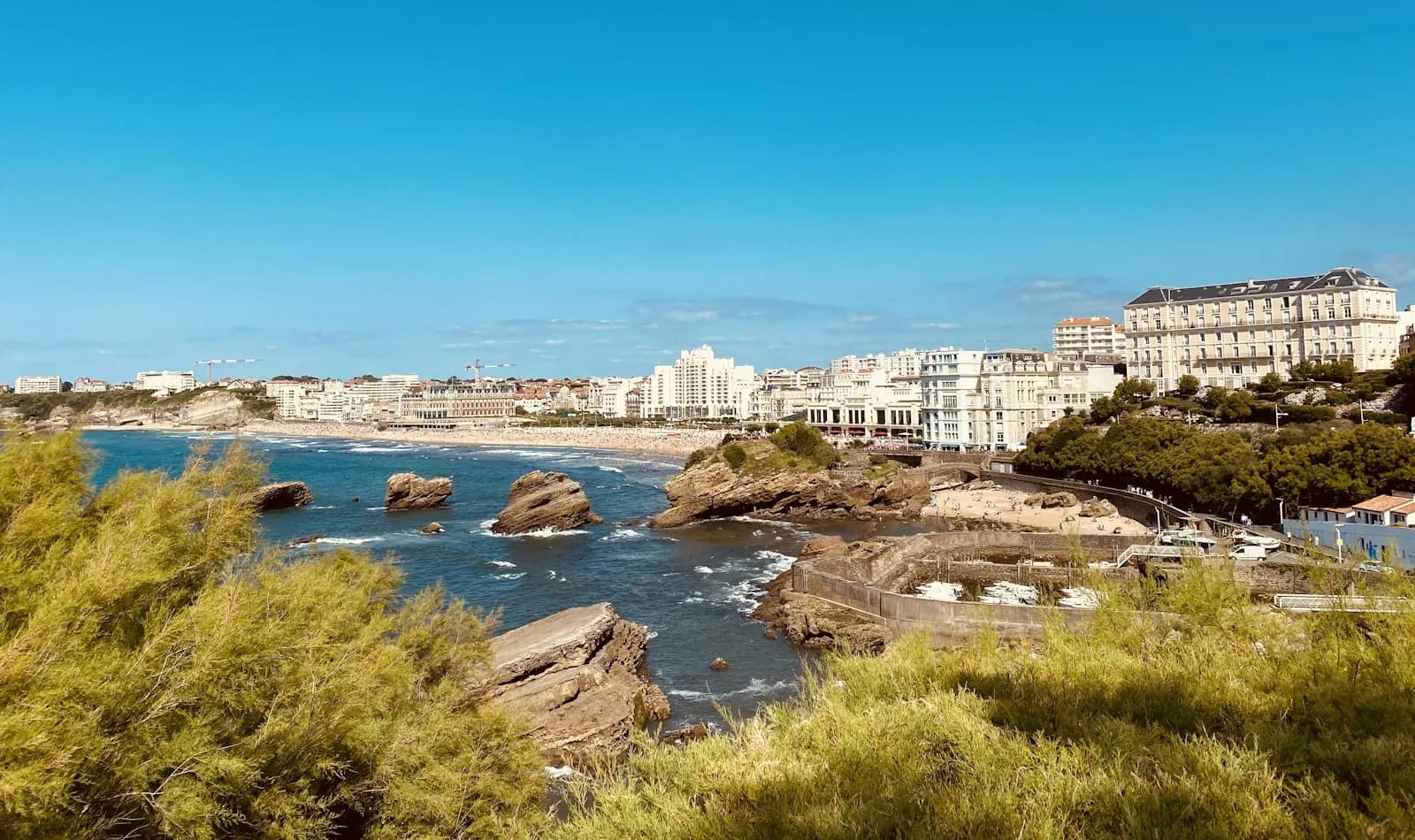
Biarritz for glamour and surf
Biarritz became fashionable after Empress Eugénie, wife of Napoleon III, had a seaside villa built here in the 1850s. That villa is now the Hôtel du Palais, which opened in 1855 and has carried the official "Palace" distinction in France since 20112. Even if you do not stay, a drink on its terrace is a classic Biarritz moment. The town is also Europe's surfing capital in spirit, with the Grande Plage at its center and a promenade that rewards a slow evening walk. Choose Biarritz if you want restaurants, a casino-era seafront, and the widest choice of hotels.
Saint-Jean-de-Luz for a calmer, prettier seaside town
Saint-Jean-de-Luz has a sheltered bay, a pedestrian shopping street, and a harbor still used by working fishing boats. It feels like a village that happens to have a beach. It is my usual recommendation for couples and for anyone who finds Biarritz too busy in summer. It also has the better rail position for San Sebastián, being the last major stop before Hendaye on the Spanish border.
Bayonne for food and history
Bayonne is a working city of two rivers, half-timbered houses, and a cathedral. It is not a beach base, but it is the region's food capital. It is known for its cured ham, protected under a geographical indication, and for its chocolate tradition, which dates to the 17th century when Sephardic Jewish families brought cocoa-making to the city3. Plan a long lunch and a stroll rather than a stay.
If you are building this as a honeymoon, I would choose Saint-Jean-de-Luz or Biarritz, then add a night inland. My France honeymoon planning guide covers how I pair a coastal stop with a city.
What are the best villages to visit inland?
The interior of Labourd, the northern Basque province, is a landscape of green hills and whitewashed houses trimmed in red or green. Allow a full day, ideally with a car, since buses are limited.
Espelette and its pepper
Espelette is the home of Piment d'Espelette, a mild chili that earned AOC status in 2000 and AOP in 20024. In autumn, strings of red peppers hang from house fronts and the village looks like a painting. The pepper festival, the Fête du Piment, is held on the last weekend of October. The 2026 edition was scheduled for October 24 and 25, with free entry, but listings were drawn from event sites rather than the town's own announcement, so confirm the dates for any future year with the tourist office before you build a trip around it5. On festival Sundays the last bus back to Bayonne is early, so a car or a driver helps.
Ainhoa and Sare
Ainhoa, a short drive from Espelette, is a single-street village with perfectly kept Basque houses and a fortified church. Sare, near the Spanish border, is the gateway to La Rhune, the 905-meter summit with panoramic views over the coast and the Pyrenees. The Petit Train de la Rhune, a rack railway that has been running for over a century, climbs to the top. In 2026 the operator's season ran from March 28 to November 16, so it is closed as I write this and will reopen in spring. Check rhune.com for the 2027 calendar. Mountain weather changes quickly, so I tell clients to go on a clear morning and keep the afternoon flexible.
Saint-Jean-Pied-de-Port
This walled town on the Nive river is the traditional starting point of the French Way of the Camino de Santiago, and most Camino Francés pilgrims begin here7. You do not need to walk to enjoy it. Wander the Rue de la Citadelle, visit the Pilgrim's Office to watch walkers collect their credentials, and have lunch in the old town. For a small taste of the route, walk the first few kilometers uphill and turn back. The high mountain crossing to Roncesvalles is generally closed in winter, so the pilgrim crowds are a spring-to-autumn feature.
What should you eat and drink in the Basque Country?
Food is the reason many of my clients choose this region, and a few terms will help you order with confidence. If you are new to French dining customs, my guide to French food etiquette is a good companion read.
- Pintxos and tapas culture. On the French side, you will find pintxos bars in Biarritz, Bayonne, and Saint-Jean-de-Luz, but the full, bar-hopping tradition is strongest in San Sebastián.
- Axoa. A slow-cooked minced or diced veal dish with peppers and onions, seasoned with Espelette pepper. It is traditionally served at festivals and is excellent in the cooler months4.
- Gâteau basque. A buttery cake filled with pastry cream or black cherry jam, traditionally linked to Cambo-les-Bains in the 19th century3. Try both fillings and decide which camp you belong to.
- Piperade. Peppers, tomatoes, and onions cooked with Espelette pepper, often topped with eggs or ham.
- Bayonne ham and chocolate. Buy the ham from a market stall and the chocolate from a Bayonne chocolatier. Both travel well.
Irouléguy wine
Irouléguy is the Basque Country's own appellation, in the foothills near Saint-Étienne-de-Baïgorry. It holds AOC status since 1970, after earlier classification in the 1950s, and the local cooperative accounts for most of its production8. The reds are robust and the whites are lively with seafood. If you are curious about French wine regions in general, my Bordeaux wine country guide for beginners is a natural next step, since Bordeaux is the train stop between Paris and the Basque coast.
How do you take a day trip to San Sebastián?
San Sebastián is about an hour and a quarter from Saint-Jean-de-Luz by train. Take the French regional train to Hendaye, a trip of about 11 to 14 minutes, then change to the Euskotren "Topo," which runs from Hendaye to San Sebastián in roughly 40 minutes9. Some booking sites show much longer journeys for this route, which appears to reflect a slow multi-leg routing, so check the Euskotren timetable directly. The Topo ends at Amara station, which is not the main Renfe station but is walkable to the center.
In San Sebastián, I send clients to the old town for pintxos, then to La Concha beach for a walk before the return train. Spain eats late, so a mid-afternoon arrival and an early-evening snack in the old town suits the schedule. Bring a passport, since this is a different country and you may face spot checks.
How do you get to the French Basque Country?
By train from Paris
The TGV INOUI runs from Paris Montparnasse to Biarritz in about four hours, with trains continuing through Bayonne and Saint-Jean-de-Luz to Hendaye. Some services to Saint-Jean-de-Luz take around four and a half hours1. Seat reservations are mandatory on these trains, so book early for summer. My French train travel tips explain how to book and which station to use.
By air
Biarritz Pays Basque Airport is the closest, with seasonal and year-round connections to Paris and other European cities. For most American travelers, the simplest plan is to fly into Paris, take the train south, and build a Paris night at either end.
Getting around once you arrive
You can do the coast by train and bus. The inland villages are far easier with a car or a private driver. I often recommend a driver for one inland day so that nobody has to drive and taste wine.
When is the best time to visit the French Basque Country?
June and September are my top picks. The sea is swimmable by late June, the beaches are lively without the crush of July and August, and restaurants run on their full schedules. Winters are mild by French standards, which makes the coast a quiet, moody option, though some seasonal attractions, including La Rhune's train, close. Two events are worth planning around if they appeal: the Fêtes de Bayonne is a five-day, white-and-red festival in July (the 2026 edition ran from July 15 to 19)10, and the Espelette pepper festival in late October. Both are crowded and joyful, but book well ahead. For a national comparison, see my best time to visit France guide.
Travelers who also plan Italy can compare with the best time to visit Italy on our sister site, since many of the same shoulder-season rules apply.
Plan your Basque Country trip with Tamar
The French Basque Country rewards a plan that mixes coast, countryside, and a border crossing without rushing any of them. If you would like help choosing a base, arranging a private driver for the inland villages, or fitting the region into a longer France itinerary, get in touch and plan it with Tamar.
Frequently Asked Questions
How long does the train from Paris to Biarritz take?
About four hours by direct TGV INOUI from Paris Montparnasse, with some services to Saint-Jean-de-Luz taking slightly longer. Seat reservations are required, so book as soon as schedules open.
Is the French Basque Country worth visiting without a car?
Yes, for the coast. Biarritz, Bayonne, and Saint-Jean-de-Luz are linked by short train rides, and San Sebastián is reachable by train. For Espelette, Ainhoa, Sare, and Saint-Jean-Pied-de-Port, a car or private driver makes the day far easier.
When is the Espelette pepper festival?
It is held on the last weekend of October. The 2026 festival was scheduled for October 24 and 25, with free admission. Check with the tourist office for next year's dates before booking.
Can you visit San Sebastián as a day trip from Biarritz or Saint-Jean-de-Luz?
Yes. From Saint-Jean-de-Luz, take a regional train to Hendaye and then the Euskotren Topo to San Sebastián, about an hour and a quarter in total. Bring your passport.
Does the La Rhune train run all year?
No. It operates seasonally. The 2026 season ran from March 28 to November 1, and it reopens in spring. Check the operator's website for 2027 dates.
References
- Biarritz Tourisme / Rail Europe — "How to get to Biarritz" and "Biarritz to Saint-Jean-de-Luz by train" (2026). destination-biarritz.fr
- Ville de Biarritz — "Hôtel du Palais" (historical walks). biarritz.fr
- France.fr — "Local Basque specialities" (Atout France). uk.france.fr
- Tourisme 64 — "Espelette and its pimento, the star spice of the Basque Country" (2026). tourisme64.com
- Guide du Pays Basque — "Fête du Piment d'Espelette" event listing (2026). guide-du-paysbasque.com
- Train de la Rhune — "Buy online" and 2026 season information. rhune.com
- Wise Pilgrim — "Saint-Jean-Pied-de-Port on the Camino Francés". wisepilgrim.com
- Nouvelle-Aquitaine Tourisme — "Irouléguy, a vineyard between earth and sky in the Basque Country". nouvelle-aquitaine-tourisme.com
- The Man in Seat 61 — "Paris to San Sebastián by train" (Hendaye to San Sebastián Euskotren Topo). seat61.com
- Guide du Pays Basque — "Fêtes de Bayonne 2026". guide-du-paysbasque.com