
Just two hours from Paris, the rolling green countryside of Normandy unfolds—a region where world history was made and remade, where Gothic cathedrals rise above medieval streets, and where apple orchards, dairy farms, and coastal villages preserve a France that feels wonderfully distant from the capital's intensity.
Why Normandy Calls
Normandy occupies a peculiar position in the French imagination: close enough to Paris for regular exchange, yet distinct enough to maintain its own identity, climate, and traditions. This is not the sun-drenched South that seduces with warmth and light; Normandy's appeal lies in gentler atmospheres—the soft greens of its dairy pastures, the grey stone of its villages, the drama of its northern coastline, the profound historical weight that settles over beaches and cemeteries alike.
For visitors basing a first week in Paris, Normandy offers several compelling day trips and forms the foundation for longer explorations. The region divides naturally into themes: the D-Day beaches and their memorials; the architectural wonders from Mont-Saint-Michel to Rouen's cathedral; the Impressionist landscapes of Giverny and the Alabaster Coast; the gastronomic pleasures of cider, Calvados, and cheeses. Many travelers combine multiple themes in multi-day itineraries that reveal Normandy's unexpected depth.
The ease of access from Paris—fast trains to major cities, rental car options for countryside exploration—makes Normandy the obvious choice for those seeking French experience beyond the capital without the complexity of distant travel.
The D-Day Beaches: History's Shores
Understanding the Landings
On June 6, 1944, the largest amphibious invasion in history unfolded along 80 kilometers of Normandy coastline. Operation Overlord, as the invasion was code-named, landed approximately 156,000 Allied troops on five beaches—code-named Utah, Omaha, Gold, Juno, and Sword—beginning the liberation of Western Europe from Nazi occupation.1
The human cost was staggering: approximately 10,000 Allied casualties on the first day alone, with several thousand killed.2 The beaches where this sacrifice occurred—now peaceful stretches of sand visited by tourists and locals alike—retain an atmosphere of profound solemnity that transcends normal tourism.
Visiting the D-Day sites requires preparation. The events were complex, the beaches spread across considerable distance, and understanding what happened where demands either guided expertise or significant advance research. Rushed visits miss the point; these places deserve the time required to grasp their significance.
Omaha Beach and the American Cemetery
For American visitors particularly, Omaha Beach represents the heart of the D-Day experience. This broad strand witnessed the invasion's heaviest fighting—German defenses here were strongest, the assault waves suffered devastating casualties, and the outcome hung in doubt for hours before sheer courage and determination secured the beach.
Today, Omaha Beach appears as a peaceful expanse of sand, with only monuments and the bluff positions revealing its history. Walking the beach, understanding the distances soldiers had to cross under fire, grasping the height of the cliffs they eventually scaled: these experiences communicate what statistics cannot.
Above the beach, the Normandy American Cemetery and Memorial contains the graves of 9,387 American service members, their white marble crosses and Stars of David arranged in perfect rows across 172 acres.3 The visitor center provides essential context, while the cemetery itself—maintained in immaculate condition by the American Battle Monuments Commission—achieves powerful dignity.
The experience of visiting the cemetery affects visitors profoundly. The scale of sacrifice, the youth of those buried (many were teenagers), the distance from their American homes: these realities emerge gradually as visitors walk among the graves, reading names and states of origin, confronting the human cost of victory.
Other Key Sites
Pointe du Hoc: Between Omaha and Utah beaches, this dramatic promontory required special attention during the invasion—German guns positioned here could hit both beaches. American Rangers scaled the 30-meter cliffs under fire in one of D-Day's most audacious actions. The cratered landscape, largely unchanged since 1944, reveals the bombardment's intensity.4
Utah Beach: The westernmost American landing, Utah saw significantly lighter casualties than Omaha despite landing forces approximately 2,000 meters south of planned positions. The Utah Beach Museum, built on the actual landing site, provides comprehensive documentation of the American airborne and seaborne operations.
Juno Beach: Canadian forces landed here, suffering heavy initial casualties before pushing inland. The Juno Beach Centre, created by Canadian initiative, honors their sacrifice while examining Canada's broader World War II contribution.
Arromanches: This small town preserves the most significant remains of the Mulberry harbors—artificial ports towed across the Channel to supply the invasion forces. Concrete caissons still visible offshore demonstrate the engineering ambition that made sustained operations possible.
Planning D-Day Visits
The beaches stretch approximately 80 kilometers from Utah in the west to Sword in the east. Meaningful visits require choices:
Day trip from Paris: Focus on either American sites (Utah, Pointe du Hoc, Omaha, American Cemetery) or British/Canadian sites (Gold, Juno, Sword), not both. Guided tours provide essential context and efficient transportation.
Two-day visits: Cover both sectors meaningfully, add the Caen Memorial (France's primary World War II museum), and include Arromanches.
Extended stays: Base in Bayeux or Caen for comprehensive exploration, adding sites like the German cemetery at La Cambe, the Airborne Museum at Sainte-Mère-Église, and quieter memorials away from main tourist routes.
Mont-Saint-Michel: The Marvel
Approaching the Marvel
Visible from kilometers away across its tidal bay, Mont-Saint-Michel rises like an apparition—a cone of granite crowned by a Gothic abbey, surrounded by medieval walls, seemingly floating between earth and sky. This is France's most iconic silhouette after the Eiffel Tower, a UNESCO World Heritage Site that has drawn pilgrims and travelers for over a thousand years.5
The island's geography creates its drama. Rising 80 meters above the surrounding flats, connected to the mainland only by a modern causeway (replacing an earlier dam), Mont-Saint-Michel experiences tidal variations among Europe's most extreme—up to 15 meters between low and high water. At high tide, the mount becomes an island; at low tide, it surveys vast expanses of sand and mud.
The settlement began in 708 CE when, according to legend, the Archangel Michael appeared to the local bishop, commanding him to build a church on the rocky isle.6 The abbey grew through centuries of royal and ecclesiastical patronage, achieving its current Gothic splendor during the 13th century. The surrounding village developed to serve the abbey and accommodate pilgrims, creating the layered medieval streetscape that visitors navigate today.
Visiting Strategies
Mont-Saint-Michel's fame generates challenges. Approximately 2.5 million visitors arrive annually, creating crowds that can overwhelm the narrow streets and small spaces.7 Strategic planning improves the experience considerably:
Timing: Early morning (before 10:00 AM) or late afternoon (after 4:00 PM) provides the best experience. Midday sees maximum crowds and tour-bus congestion.
Overnight stays: Staying on the mount itself—several hotels operate within the walls—transforms the experience. Evening and early morning, when day-trippers have departed or not yet arrived, reveal Mont-Saint-Michel's medieval atmosphere.
The abbey: This is the essential visit. The climb through the village, up the Grand Degré stairway, to the abbey church and cloister rewards with both architectural magnificence and panoramic views. Guided tours (included with admission) illuminate the complex's history and function.
Tides: If visiting coincides with high tide, the sight of water surrounding the mount creates particular drama. The tourist office publishes tide tables; planning accordingly adds memorable dimension.
The bay: Guided walks across the tidal flats (quicksand makes independent crossing dangerous) reveal the ecosystem and geology that make Mont-Saint-Michel's setting unique. These excursions require advance booking and appropriate footwear.
From Paris to the Mount
Mont-Saint-Michel lies approximately 350 kilometers from Paris—too far for comfortable day trips but manageable with early departure and commitment.
By train and bus: TGV to Rennes (approximately 2.5 hours), then bus to Mont-Saint-Michel (approximately 75 minutes). The total journey of 4+ hours each way makes this exhausting for day trips.
By car: Approximately 4 hours from Paris via A13 and A84. Car provides flexibility but shares the duration challenge.
Organized tours: Day tours depart Paris early, handle all logistics, and include guide services. The long travel hours limit time at the mount but simplify planning.
Better approach: Combine Mont-Saint-Michel with other Normandy destinations in a multi-day itinerary. Stay overnight in the vicinity, experience the mount in evening light, then continue to D-Day beaches, Rouen, or other destinations.
Rouen: The Gothic City
Cathedral and History
The capital of Normandy, Rouen served as one of medieval Europe's great cities—wealthy from textile trade, significant as seat of Norman dukes and later English kings, marked forever by the trial and execution of Joan of Arc in 1431. Today's Rouen preserves remarkable medieval architecture alongside a vibrant contemporary city, making it perhaps Normandy's most rewarding urban destination.8
The cathedral dominates the city visually and historically. This Gothic masterpiece, its construction spanning the 12th through 16th centuries, so fascinated Claude Monet that he painted it over 30 times, capturing the facade's transformations through changing light and seasons.9 The interior continues the impression of accumulated magnificence—stained glass, tombs, chapels accumulated over centuries of devotion and patronage.
The old town surrounding the cathedral preserves half-timbered houses from medieval and Renaissance periods in quantities unmatched elsewhere in France. Walking the Rue du Gros-Horloge, admiring the 14th-century astronomical clock that spans the street, visitors encounter living history rather than museum reconstruction.
Beyond the Cathedral
Place du Vieux-Marché: The square where Joan of Arc was burned at the stake in 1431. A modern church dedicated to the saint occupies part of the site, its striking architecture incorporating medieval stained glass salvaged from a church destroyed in World War II.
Église Saint-Maclou: A jewel of Flamboyant Gothic architecture, this church near the cathedral showcases the decorative exuberance that characterized late medieval building.
Aître Saint-Maclou: One of Europe's rare surviving medieval charnel houses, this macabre complex once processed victims of plague epidemics. The carved skulls and bones decorating its timber galleries create an atmosphere unlike anywhere else.
Musée des Beaux-Arts: Among France's finest provincial museums, with works spanning centuries and including significant Impressionist holdings.
Rouen from Paris
Rouen's proximity to Paris—approximately 135 kilometers—makes it ideal for day trips:
By train: Direct trains from Paris Saint-Lazare take approximately 70 minutes — see our French train travel tips for booking strategy. The station sits close to the city center; everything significant is walkable.
By car: Approximately 90 minutes via A13, with various route options. Parking can challenge in the medieval center.
Rouen combines well with Giverny (40 kilometers south) for a day exploring both the cathedral city and Monet's gardens.
Giverny: Monet's Vision
The Gardens and the Light
Claude Monet discovered Giverny while traveling by train, captivated by glimpses of the village from the railway. He moved there in 1883 and remained until his death in 1926, creating in the process the gardens that became his primary subject and his legacy to visual culture.10
The property divides into two distinct areas: the Clos Normand, a flower garden of remarkable color and density surrounding the pink house where Monet lived; and the water garden across the road, where the Japanese bridge, weeping willows, and water lilies inspired the painter's most famous works.
Visiting Giverny today means walking through Impressionism—not museum pieces behind glass but the actual views that Monet painted, maintained in conditions approximating his vision. The water lilies bloom through summer months; the wisteria drapes the bridge in May; the flower garden explodes with color from spring through autumn. The experience approaches pilgrimage for art lovers.
The house, preserved with its collections of Japanese prints and the blue-and-yellow kitchen that appears in countless photographs, provides domestic context for the gardens' artistic purpose. This was a working artist's home, the gardens simultaneously personal pleasure and professional subject.
Practical Giverny
Getting there: Trains from Paris Saint-Lazare to Vernon (approximately 45 minutes) connect with shuttle buses, bikes, or taxis covering the remaining 7 kilometers to Giverny.
When to visit: The gardens open from late March through early November. Late April through June provides the most spectacular bloom; summer brings water lilies but also maximum crowds. Morning visits, before tour buses arrive, offer the best experience.
Time required: Two to three hours allows thorough appreciation of both gardens and house. Those combining with Rouen should account for travel time between destinations.
Crowds: Giverny receives over 500,000 annual visitors concentrated in a short season.11 Weekday mornings provide the best conditions; weekend afternoons see the most congestion.
Norman Cuisine and Countryside
The Foods of Normandy
Norman cuisine reflects the region's agricultural abundance—dairy farms producing some of France's finest butter, cream, and cheese; orchards yielding apples transformed into cider and Calvados; coastal waters providing exemplary seafood.
Cheeses: Normandy claims four AOC cheeses, each distinct:
- Camembert: The famous soft cheese, best when purchased from Norman producers rather than industrial versions
- Livarot: Stronger flavored, washed-rind, distinctive for the strips of sedge grass binding it
- Pont-l'Évêque: Soft and square, milder than Livarot
- Neufchâtel: Heart-shaped when intended as a gift, otherwise cylindrical; bloomy rind similar to Camembert
Apples and their products: Norman apple orchards produce cider ranging from sweet to bone-dry, Calvados (apple brandy) aged in oak to remarkable smoothness, and Pommeau (cider blended with Calvados). The Route du Cidre through the Pays d'Auge region visits producers welcoming tastings.
Seafood: The coast provides exceptional oysters (particularly from the bay of Mont-Saint-Michel), mussels, scallops, sole, and turbot. Preparations emphasize quality ingredients and Norman cream-based sauces.
Meat: Pre-salé lamb, grazed on the salt marshes surrounding Mont-Saint-Michel, develops distinctive flavor prized throughout France. Andouille sausage from Vire, made from tripe, is a Norman specialty.
The Countryside Experience
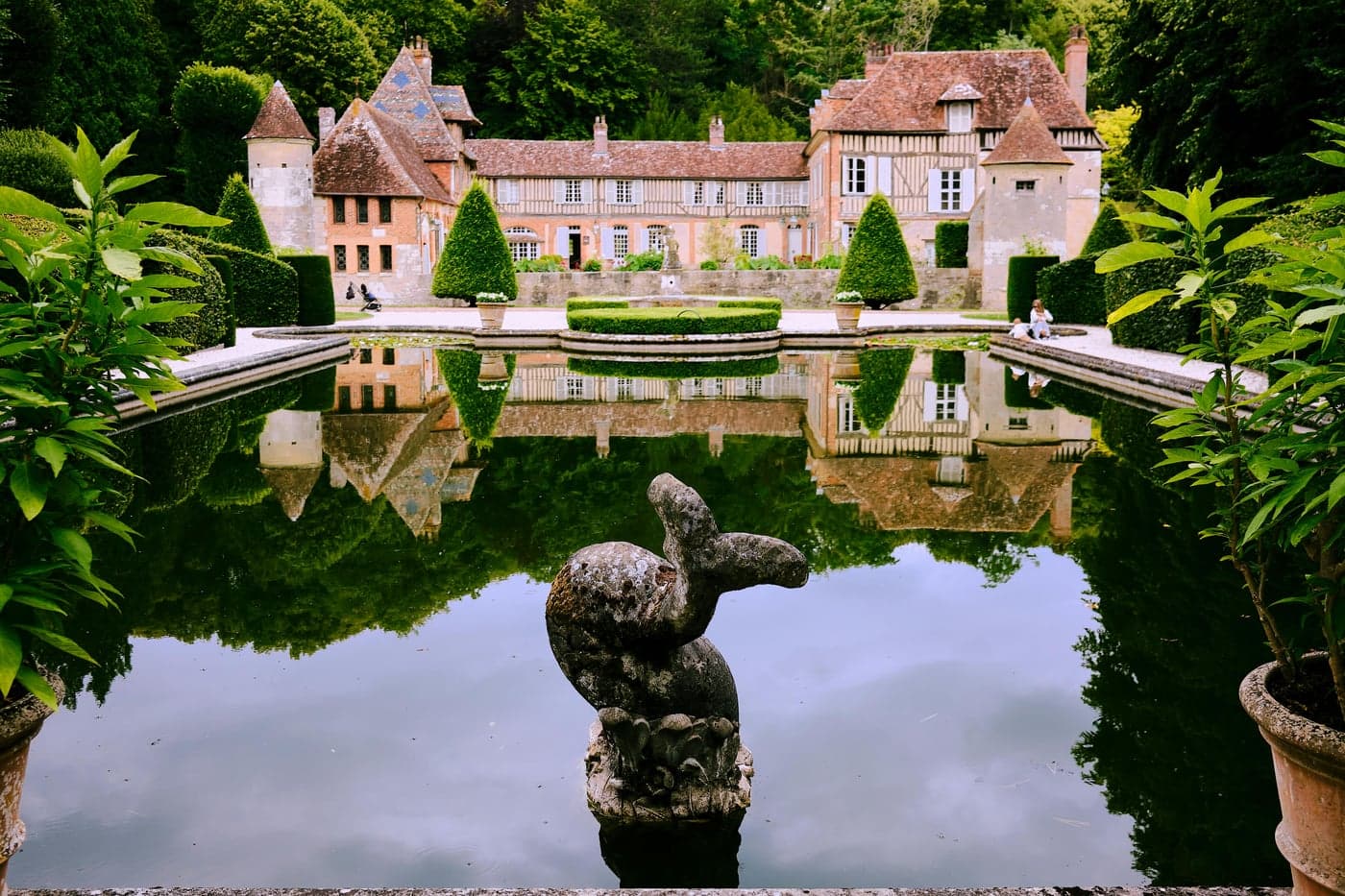
Beyond the major sights, Norman countryside rewards exploration. The Pays d'Auge, east of Caen, presents the Normandy of imagination: half-timbered farmhouses, apple orchards, dairy cattle, hedge-lined lanes. The Route du Cidre connects producers and provides structure for aimless wandering.
The Suisse Normande, despite its name, lies in Normandy, not Switzerland. This hilly region along the Orne River offers hiking, rock climbing, and dramatic scenery at odds with Normandy's typical flatness.
The Côte Fleurie (Flowery Coast)—Deauville, Trouville, Honfleur—combines elegant beach resorts, fishing harbors, and the sophisticated atmosphere that has attracted Parisian society for over a century.
Planning Your Normandy Experience
Day Trip Options from Paris
Giverny + Rouen (full day): Train to Vernon for Giverny, then onward to Rouen for afternoon and evening. Return to Paris by evening train.
D-Day beaches (full day, guided): Organized tours depart Paris early, cover major American sites (or British/Canadian alternatives), and return by evening. Long day but efficient.
Mont-Saint-Michel (long day or overnight): Day trips possible but exhausting; overnight allows meaningful experience.
Rouen alone (half or full day): Easy day trip by train, leaving time for unhurried exploration.
Multi-Day Itineraries
Three days (recommended minimum):
- Day 1: Paris to Rouen (visit cathedral, old town); continue to Bayeux or Caen
- Day 2: D-Day beaches (full day with guide or rental car)
- Day 3: Mont-Saint-Michel; return to Paris
Five days (comprehensive):
- Day 1: Giverny and Rouen
- Day 2: D-Day beaches, American sector
- Day 3: D-Day beaches, British/Canadian sector; Bayeux Tapestry
- Day 4: Mont-Saint-Michel
- Day 5: Pays d'Auge (cider route), return via Honfleur
Getting Around
By train: Excellent service to major cities (Rouen, Caen, Bayeux) but limited for reaching D-Day beaches and countryside.
By car: The most practical option for comprehensive exploration. Rental from Paris or Norman cities provides flexibility essential for rural sites.
Guided tours: Ideal for D-Day beaches, where expertise adds essential understanding. Various operators serve both Paris-based day trips and Normandy-based excursions.
Accommodation
Bayeux: The obvious base for D-Day exploration—charming town with good hotels and restaurants, easy access to beaches and the famous tapestry depicting the 1066 Norman conquest of England.
Caen: Larger city with more accommodation options, excellent Memorial museum, wartime history of its own (heavily damaged in 1944 fighting).
Mont-Saint-Michel vicinity: Several villages near the mount offer hotels and guesthouses; staying on the mount itself provides unique experience at premium prices.
Rouen: Normandy's capital offers urban amenities and makes a good base for northeastern exploration.
Frequently Asked Questions
Can I visit the D-Day beaches as a day trip from Paris?
Yes, but it requires commitment—early departure, organized tour or rental car, focus on one sector (American or British/Canadian). The experience rewards but also exhausts. Multi-day visits allow deeper appreciation.
Is Mont-Saint-Michel worth the trip from Paris?
Absolutely, but the distance (4+ hours each way) makes day trips grueling. Better to incorporate Mont-Saint-Michel into a multi-day Normandy itinerary or stay overnight on the mount or nearby.
When is the best time to visit Normandy?
Late spring (May-June) offers pleasant weather, blooming gardens at Giverny, and manageable crowds. Summer brings peak season at all sites. Early autumn (September-October) provides excellent conditions with diminishing visitors. D-Day anniversary (June 6) sees commemorative events and significant crowds.
Should I rent a car in Normandy?
For D-Day beaches, countryside exploration, and multi-site itineraries, yes. For Rouen or Giverny day trips from Paris, trains suffice. Mont-Saint-Michel is accessible by public transport but car provides flexibility.
How many days do I need for Normandy?
One day allows a single focus (Rouen, Giverny, or D-Day basics). Three days cover major highlights meaningfully. Five days enable comprehensive exploration including countryside and multiple themes.
Is the Bayeux Tapestry worth seeing?
Yes—this 70-meter embroidered narrative of the 1066 Norman Conquest is unique in medieval art. The audio guide illuminates scenes that might otherwise confuse. Combined with Bayeux's charming old town, it makes an excellent complement to D-Day visits.
References
- Beevor, Antony. "D-Day: The Battle for Normandy." Viking, 2009.
- National D-Day Memorial Foundation. "D-Day Casualty Figures." Research Documentation, 2019.
- American Battle Monuments Commission. "Normandy American Cemetery and Memorial." Official Guide, 2023.
- Ambrose, Stephen E. "The Pointe du Hoc: Rangers' Achievement." American Heritage, 1994.
- UNESCO World Heritage Centre. "Mont-Saint-Michel and its Bay." World Heritage List Documentation, 1979.
- Centre des Monuments Nationaux. "Abbey of Mont-Saint-Michel: History and Architecture." Official Guide, 2022.
- French Ministry of Culture. "Visitor Statistics: Mont-Saint-Michel 2023." Paris, 2024.
- Office de Tourisme de Rouen. "Rouen: Historical Guide." Rouen, 2023.
- Wildenstein Institute. "Monet: Catalogue Raisonné—Rouen Cathedral Series." Documentation, 2010.
- Fondation Claude Monet. "Giverny: History and Gardens." Official Guide, 2023.
- French Ministry of Culture. "Visitor Statistics: Monet Foundation Giverny 2023." Paris, 2024.