
Beyond Arles, where the Rhône branches into channels seeking the sea, a different France emerges—a landscape of water and sky, of salt flats shimmering in summer heat, of white horses and black bulls and flamingos painting the marshes pink.
Europe's Greatest Wetland
The Camargue occupies the Rhône delta where France's mightiest river finally reaches the Mediterranean. This vast triangle of land—approximately 930 square kilometers—exists in perpetual negotiation between fresh and salt water, land and sea, wilderness and human use. The result is one of Europe's most significant wetland ecosystems and one of France's most unexpected landscapes.1
First-time visitors often find the Camargue disorienting. This bears no resemblance to Provençal postcard imagery of lavender fields and hilltop villages. The terrain is flat, the horizons enormous, the aesthetic minimalist. Colors reduce to essentials: the blue-white of sky and water, the green of reeds and rice, the salt-white of evaporating marshes, the pink of flamingos concentrated in startling flocks. Beauty here demands adjustment; those who make the effort discover singular reward.
The Camargue's protected status—the Parc Naturel Régional de Camargue covers much of the area, with stricter protection in the Réserve Nationale de Camargue—reflects both ecological importance and cultural significance. This is home to the gardians, traditional cowboys who manage the black Camargue bulls; to communities maintaining centuries-old salt harvesting; to flamingo colonies whose survival depends on these specific conditions. Preservation balances with sustainable use in ways that offer lessons for threatened wetlands worldwide.
The Wildlife
Flamingos: The Camargue's Pink Signature
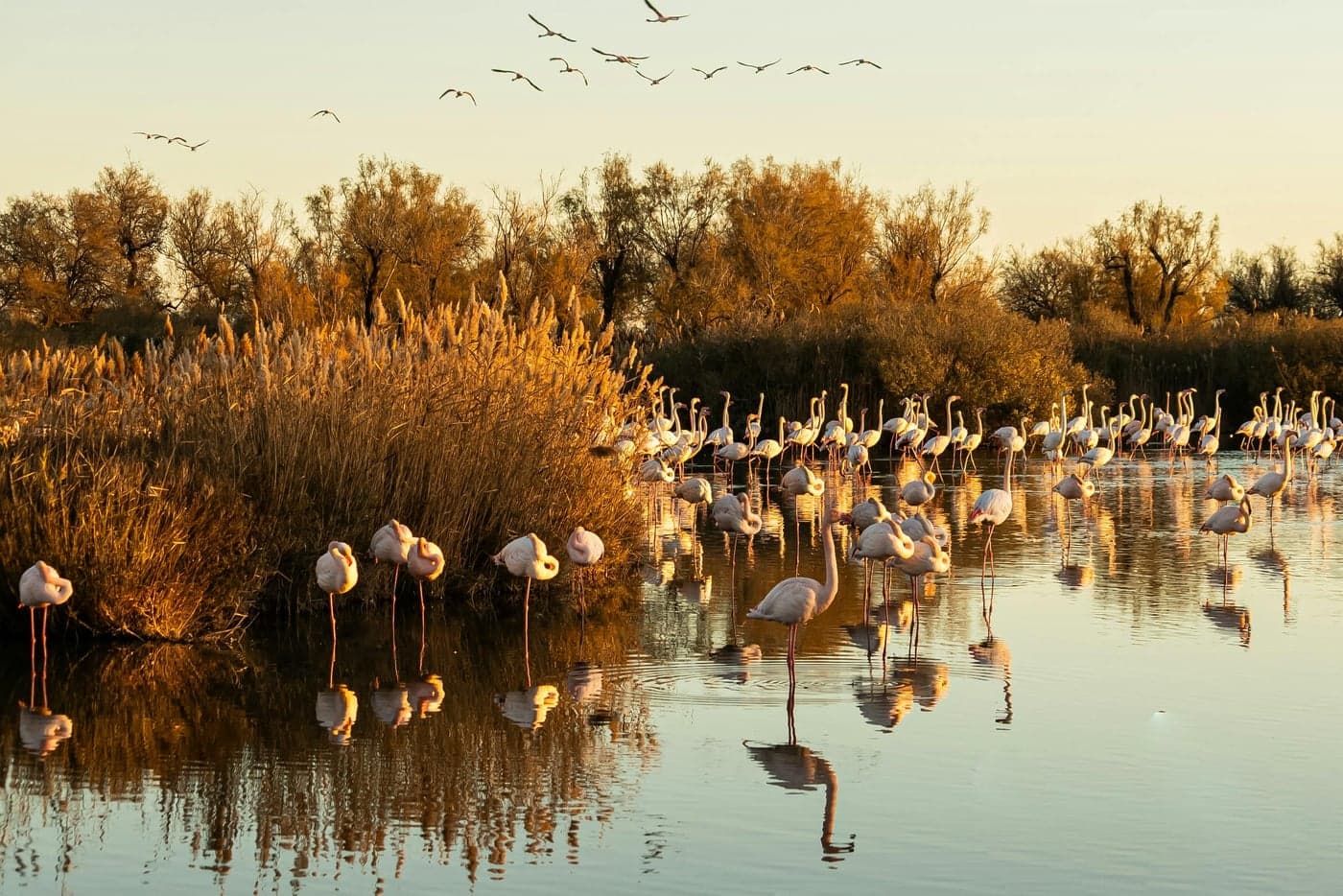
Greater flamingos have nested in the Camargue since at least Roman times, but their presence here has never felt guaranteed. Populations fluctuated wildly through the 20th century; habitat loss and disturbance threatened survival. Conservation efforts since the 1970s—particularly creation of protected nesting sites at the Fangassier lagoon—have stabilized and grown the population to approximately 20,000-40,000 birds, making this Western Europe's only regular flamingo breeding site.2
Flamingo viewing has become the Camargue's signature experience. The birds congregate at several accessible locations—the Parc Ornithologique de Pont de Gau offers guaranteed sightings at close range, while wilder viewing awaits along roads crossing the marshes. Their improbable color—derived from carotenoid pigments in the crustaceans they filter from shallow waters—never normalizes; each sighting startles anew.
The birds' behavior rewards patience. Watch for the elaborate courtship displays during breeding season (spring), the feeding posture with head inverted, the mass flights that paint portions of sky pink. Early morning and late afternoon light enhances both viewing conditions and photographic opportunity.
Camargue Horses: The White Herd
The small white horses of the Camargue—actually born dark and lightening with age—have lived semi-wild in these marshes for centuries, possibly millennia. Their origin remains debated: some claim descent from prehistoric horses depicted in cave paintings; others trace them to mounts brought by Moorish invaders. Whatever their ancestry, Camargue horses have adapted perfectly to their environment—able to survive on sparse marsh vegetation, comfortable in water, hardy against the extremes of Provençal climate.3
Today, most Camargue horses belong to manades (livestock operations) that manage them in traditional semi-wild conditions. The horses work alongside gardians herding the black bulls that provide another component of Camargue identity. For visitors, horseback riding offers perhaps the most authentic way to experience the landscape—following trails through marshes, crossing shallow channels, connecting with a tradition that defines this place.
Several operations offer riding experiences ranging from one-hour introductions to multi-day expeditions camping in the marshes. Experience requirements vary; complete beginners can find gentle introductions, while accomplished riders can access more challenging terrain.
The Birds Beyond Flamingos
While flamingos draw attention, the Camargue hosts extraordinary avian diversity—over 400 species recorded, making it one of Europe's premier birding destinations.4 Resident and breeding species include herons (grey, purple, night, and squacco), egrets, avocets, stilts, and various duck species. Migration seasons bring countless additional species passing between African wintering grounds and European breeding territories.
Prime birding sites include:
- Parc Ornithologique de Pont de Gau: The most accessible site, with walking trails and observation posts arranged for optimal viewing
- Étang de Vaccarès: The largest lagoon, its shores offering varied habitat and species
- La Capelière: The nature reserve's visitor center, providing guided tours and observation opportunities
- Marais du Vigueirat: Exceptional diversity in restored wetland habitat
Best timing: Spring (April-June) for breeding activity and early migrants; autumn (September-November) for southward migration; winter for overwintering species including various raptors.
Bulls and Guardians
The black Camargue bull—smaller and more agile than its Spanish fighting cousin—provides the region's other signature animal. These bulls are raised for the course camarguaise, a traditional spectacle in which young men attempt to snatch rosettes from between the horns of charging bulls. Unlike Spanish bullfighting, the course camarguaise is bloodless (for bulls at least; human injuries occur) and the bulls, rather than being killed, return to pastures as celebrities with growing reputations.5
The gardians who manage these bulls on horseback represent a cultural tradition comparable to American cowboys or Spanish vaqueros. Their distinctive costume—wide-brimmed hat, printed shirts, trident-like stick—appears throughout Camargue imagery. While mechanization has reduced the number of working gardians, the tradition maintains cultural importance and tourism visibility.
The Landscape
Understanding the Delta
The Camargue's geography requires understanding to appreciate. The Rhône, carrying sediment from its entire watershed, has built this delta over millennia, depositing new land as it reaches the sea. Simultaneously, Mediterranean currents and storms reshape the coastline, creating a landscape in constant flux.6
The area divides into several distinct zones:
Haute Camargue (upper Camargue): Agricultural land along the upper delta, where rice cultivation and other farming have modified the natural landscape while maintaining wetland character.
Camargue proper: The heartland of marsh, lagoon, and salt flat that defines the region's identity. The Étang de Vaccarès, covering approximately 6,000 hectares, dominates this zone.
Petite Camargue: West of the Petit Rhône, a smaller section administratively part of the Gard département but ecologically contiguous.
The salinity gradient—from fresh in the north to increasingly salty toward the sea—creates distinct ecological zones supporting different plant and animal communities. Salt marshes in the south support halophytic (salt-tolerant) vegetation; freshwater marshes farther inland host different species assemblages.
Salt of the Earth
Salt harvesting from the Camargue dates to antiquity, and the modern industry—centered on the Salin-de-Giraud works—produces approximately one million tons annually.7 The process uses traditional methods: seawater is channeled into shallow ponds where evaporation concentrates the salt; the resulting brine moves through successive ponds until crystallization occurs.
The visual result is startling: vast geometric grids of water ranging from normal blue through pink (caused by halophilic bacteria) to intensely red, depending on salinity. The mountains of harvested salt, brilliant white against delta flatness, create industrial-scale sculpture.
Visits to the salt works (available through the Camargue tourist offices) explain the process and provide access to landscapes otherwise off-limits. The experience complements natural Camargue with industrial heritage—both dependent on the same peculiar conditions.
Rice Country
French sushi lovers have the Camargue to thank: this region produces most of France's rice, a crop introduced systematically after World War II as a means of desalinating soil damaged by war-related flooding. Today, approximately 15,000 hectares of paddies produce 100,000 tons annually—a tiny fraction of global production but essential for French culinary independence.8
The rice landscape adds variety to the Camargue palette: flooded fields in spring, green growth through summer, golden harvest in September. Several producers welcome visitors for tours and tastings; Camargue rice, particularly the red and black varieties, commands premium prices in French markets.
The Towns
Saintes-Maries-de-la-Mer
The Camargue's only coastal town, Saintes-Maries-de-la-Mer serves as the region's de facto capital and primary tourist base. The town takes its name from a medieval legend: according to tradition, Mary Magdalene, Mary Salome, and Mary Jacobé (relatives of Jesus) arrived here by boat after fleeing the Holy Land, accompanied by their servant Sarah.9
The fortified church of Notre-Dame-de-la-Mer dominates the skyline—a 9th-12th century structure whose roof offers panoramic views over town and marshes. Within the crypt, a statue of Saint Sarah draws particular veneration from Roma (Gypsy) pilgrims, who gather here annually in late May for one of Europe's most colorful religious festivals.
Beyond the church, Saintes-Maries offers beach access, tourist infrastructure (hotels, restaurants, shops), and the atmospheric quality that accompanies isolation. This is not a sophisticated town—expect rustic rather than refined—but its position at the Camargue's heart makes it the natural base for exploration.
Arles
Gateway to the Camargue rather than part of it, Arles deserves inclusion in any regional exploration. This was Roman Provence's capital, and its arena, theater, and necropolis rank among France's finest ancient monuments. Van Gogh lived and worked here intensively during 1888-1889, before his final, transformative year in nearby Saint-Rémy-de-Provence, producing some of his most celebrated works—though the "Yellow House" he painted was destroyed during World War II.10
The annual photography festival (Les Rencontres d'Arles, each summer) has established Arles as a contemporary art center, with exhibitions spread throughout the city's historic buildings. The Fondation Vincent van Gogh provides dedicated exhibition space for the artist and his influence.
Arles offers urban amenities—quality restaurants, comfortable hotels, cultural attractions—that the Camargue proper lacks. Many visitors base here for day trips into the wetlands, returning each evening to reliable infrastructure.
Aigues-Mortes
On the Camargue's western edge, this perfectly preserved medieval walled town was built by Louis IX (Saint Louis) as his port of embarkation for the Crusades. The walls survive complete, offering walks along their full circuit with views over the salt flats and marshes beyond.11
The town's name—literally "dead waters"—reflects its marshy setting, which gradually silted in and ended its maritime usefulness. Today, Aigues-Mortes provides atmospheric wandering through grid-pattern streets, dining in the central square, and the most accessible medieval fortification experience in the region.
Experiencing the Camargue
On Horseback
Horseback riding represents the most authentic way to experience the Camargue's vast spaces. Numerous stables offer guided rides ranging from one-hour introductions to multi-day expeditions:
- One-hour rides: Suitable for beginners; typically stay near the stable, providing marsh and wildlife introduction
- Half-day rides: Access more remote areas; some experience helpful but not required
- Full-day rides: Cross significant terrain; moderate experience usually required
- Multi-day expeditions: Sleep in guardians' cabins or camp in the marshes; for experienced riders seeking immersion
Reputable stables match riders to appropriate horses and terrain. The experience of splashing through shallow marsh water, watching flamingos rise at your approach, feeling the space and silence: this is Camargue at its essence.
By Bike
The Camargue's flatness makes cycling appealing, and several marked routes cross the landscape. The ride from Arles to Saintes-Maries-de-la-Mer (approximately 40 kilometers) follows the Digue à la Mer—a levee road offering excellent wildlife viewing and few vehicles.
Bike rental is available in Arles, Saintes-Maries, and smaller settlements. The terrain presents no technical challenges; wind exposure (the mistral can blow strongly) and summer heat require consideration.
By Boat
Several operators offer boat trips through the marshes and along the coast. These range from flat-bottomed vessels navigating shallow channels to larger boats cruising the Petit Rhône. The perspective from water differs from land—wildlife may be more approachable, and the landscape's water-dominated character becomes viscerally apparent.
On Foot
Walking options include trails within the Parc Ornithologique, routes through the Réserve de Camargue, and beach walks along the coast. The Digue à la Mer, running 20 kilometers between Saintes-Maries and the Phare de la Gacholle lighthouse, provides an excellent half-day hike with continuous wildlife potential.
Practical Information
Getting There
By car: Arles lies approximately 90 kilometers from Marseille and 35 kilometers from Avignon, gateway to the Rhône Valley's wine country. A car is effectively essential for exploring the Camargue—public transportation serves only Arles and Saintes-Maries, leaving the interior inaccessible.
By train: Direct service from Paris (TGV to Avignon or Nîmes, then regional train to Arles). Arles station sits close to the town center.
By bus: Limited service connects Arles to Saintes-Maries-de-la-Mer, but schedules are infrequent and don't support flexible exploration.
When to Visit
Spring (April-June): Perhaps ideal—breeding birds active, flamingo colonies at their most photogenic, temperatures comfortable, marshes full. May brings the Roma pilgrimage with its colorful festivities.
Summer (July-August): Hot and busy. The landscape takes on parched appearance as water levels drop; mosquitoes can be aggressive. Beach season at Saintes-Maries.
Autumn (September-November): Migration brings varied birdlife; temperatures moderate; crowds diminish. Rice harvest adds agricultural interest.
Winter (December-March): Quiet, atmospheric, surprisingly rewarding for those accepting limited services. Overwintering birds include species absent other seasons; flamingos remain present.
Where to Stay
Saintes-Maries-de-la-Mer: The obvious base for immersion, with varied accommodation from simple hotels to comfortable guesthouses. Limited dining options; atmosphere prioritizes authenticity over sophistication.
Arles: Urban amenities, quality restaurants, cultural attractions. Use as base for day trips into the Camargue, returning to reliable infrastructure each evening.
Mas accommodations: Traditional Camargue farmhouses, some converted to guesthouses, offer atmospheric stays within the marshes. These typically require car access and may be isolated from services.
What to Bring
Essential items:
- Binoculars (wildlife viewing demands optical assistance)
- Sun protection (no shade in the marshes)
- Insect repellent (mosquitoes can be fierce, especially evening)
- Waterproof footwear (marshes are wet)
- Layers (weather can change; mistral brings sudden cold)
Photography: The Camargue rewards serious photographers. Long lenses capture wildlife; wide angles convey landscape scale; tripods help in low light. Early morning and late afternoon provide best conditions.
The Camargue Experience
Why It Matters
The Camargue represents something increasingly rare: a substantial European landscape maintaining ecological function while supporting traditional human use. The wetlands filter water, store carbon, harbor biodiversity. The cultural practices—bull herding, horse breeding, salt harvesting, rice cultivation—continue traditions adapted over centuries to this particular place.
Visiting thoughtfully—staying on marked trails, respecting wildlife distances, supporting sustainable tourism operations—contributes to preservation. The Camargue needs visitors who appreciate its value, whose economic contribution justifies continued protection against development pressure.
Adjusting Expectations
Those seeking Provençal prettiness will find the Camargue initially disappointing. This is not a picturesque landscape in conventional terms—the flatness, the industrial salt works, the somewhat scruffy towns: all may underwhelm.
The adjustment required is one of attention. Look at the light playing across water. Watch a flamingo flock rise, wheeling pink against blue sky. Listen to the silence that distance from habitation creates. Feel the wind carrying scent of salt and vegetation. The Camargue reveals itself slowly, to those patient enough to receive it.
When revelation comes—and it does, for nearly everyone who spends sufficient time—the Camargue's appeal becomes apparent. This is wild France, surviving against odds, offering experiences impossible elsewhere. It deserves the effort of understanding.
Frequently Asked Questions
Can I see flamingos year-round in the Camargue?
Yes, flamingos remain present throughout the year, though numbers fluctuate seasonally. The breeding colony (spring-summer) offers the most concentrated viewing. The Parc Ornithologique de Pont de Gau provides reliable sightings in all seasons.
Is the Camargue suitable for children?
Yes, with appropriate expectations. Children typically enjoy horse riding, flamingo viewing, and beach time at Saintes-Maries. The Parc Ornithologique provides accessible walking trails with guaranteed wildlife sightings. Summer heat and mosquitoes require management.
How many days should I spend in the Camargue?
A single day allows highlights—Parc Ornithologique, a scenic drive, perhaps a short ride. Two to three days permit fuller exploration including riding, boat trips, and wildlife watching at varied locations. Serious birders may happily spend a week.
Do I need to speak French?
Less than in many French regions. Tourism has internationalized services in Saintes-Maries and major attractions. However, remote locations and traditional operations may have limited English; basic French helps.
Is the Camargue expensive?
Moderate by French standards. Accommodation ranges from budget to comfortable but rarely reaches luxury levels. Activities (riding, boat tours) add to costs but remain reasonable. Dining options are limited in Saintes-Maries, with Arles offering better value and variety.
When is the Roma pilgrimage?
The pilgrimage to Saintes-Maries-de-la-Mer occurs annually around May 24-25, honoring Saint Sarah. The event brings colorful processions, music, and celebration—but also significant crowds and difficulty finding accommodation. Book far in advance if visiting during this period.
References
- Parc Naturel Régional de Camargue. "The Camargue: Geography and Ecology." Official Documentation, 2023.
- Tour du Valat Research Center. "Greater Flamingo Population Studies: Camargue Breeding Colony." Scientific Report, 2023.
- Associação dos Criadores do Cavalo Camargue. "The Camargue Horse: History and Standards." Breed Documentation, 2021.
- Ligue pour la Protection des Oiseaux. "Birds of the Camargue: Species Checklist." LPO Publications, 2024.
- Fédération Française de la Course Camarguaise. "History and Rules of the Course Camarguaise." Official Guide, 2022.
- CNRS. "Rhône Delta Dynamics: Sedimentology and Geomorphology." Research Publications, 2019.
- Salins du Midi. "Salt Production in the Camargue: History and Methods." Company Documentation, 2023.
- Syndicat des Riziculteurs de France. "Camargue Rice: Production and Quality." Industry Report, 2023.
- Diocese of Aix-en-Provence. "Saintes-Maries-de-la-Mer: Pilgrimage History." Ecclesiastical Archives, 2020.
- Fondation Vincent van Gogh Arles. "Van Gogh in Arles: Complete Works." Exhibition Catalogue, 2022.
- Centre des Monuments Nationaux. "Aigues-Mortes: The Medieval Walled City." Official Guide, 2023.